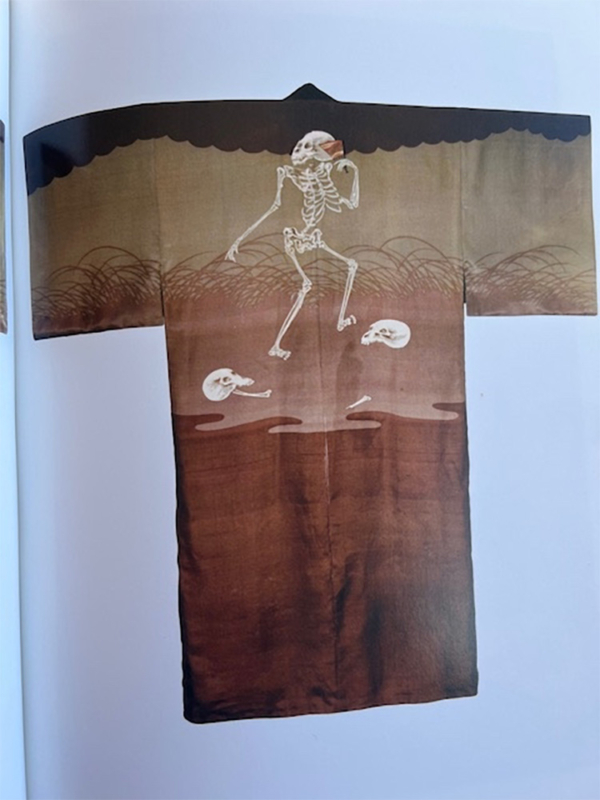
The last two months I have been obsessed with Japanese skeleton kimono. I was approached by a collector, to appraise his 47 piece textile collection, all detailed in a scholarly essay/catalogue AS WE ARE NOW SO SHALL YOU ONE DAY BE written by Jacqueline Atkins. Each of the kimono have at least two photos, if not more, with commentary by Ms. Atkins discussing the motif or a link to an artist known for similar images. These kimono are very rare and appeared on the Japanese market from 19201930, Taisho to Showa period.
There is no tradition like Day of the Dead in Japan. Most of the designs featuring skulls, seem to be a nod to the literary world. The skeletons, on the other hand, are humorous and playful like those in Kawabata Kyosai sketches. These designs on textiles appeared between 1920-1930. It was a time of world peace and exchange of ideas, architecture and modes of travel. The motif was an attempt at modernity, a repeating skull motif as Art Deco.
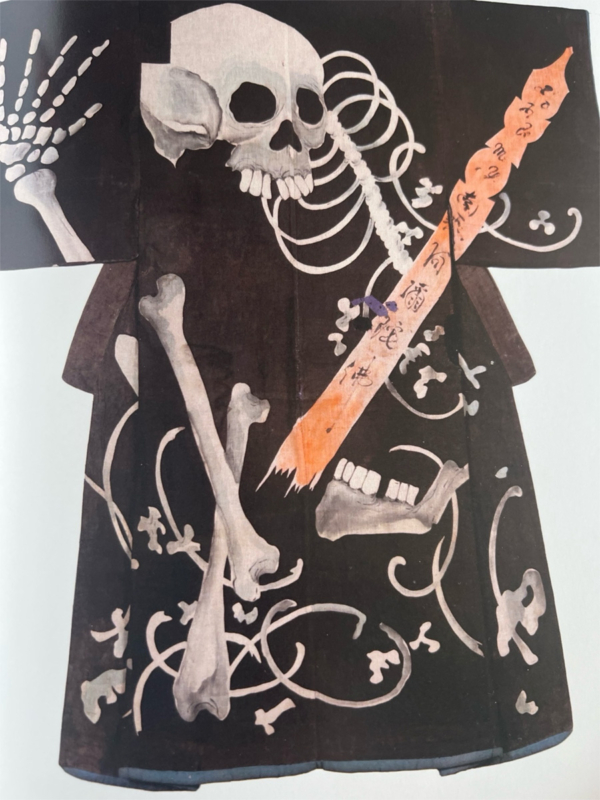
After this decade, fashion turned to airplanes and the rise of the Japanese Empire, and kimono had patriotic themes. The first kimono, Photo 1, cotton, and large skull, ribcage and thigh bones on the front with red death wood markers, must have been commissioned by a shrine patron. The owner bought the kimono from a shrine, where it might have been used as a theatrical costume as well. Most Japanese Buddhists only visit the temple upon the death of a colleague, this kimono could have been used on one of those occasions by the priests.
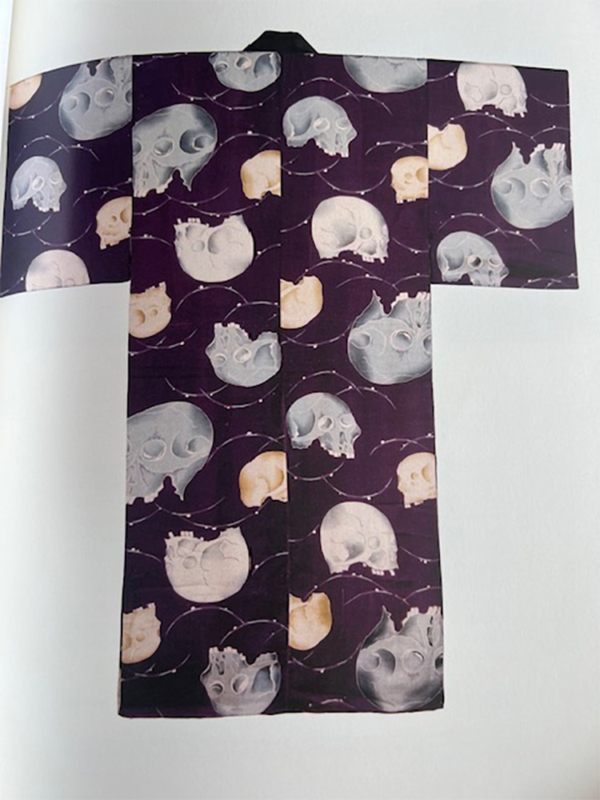
The nagajuban , cotton, in Photo 2 is of an under kimono that can be worn as at home leisure wear. The repetition of the skulls is done in quick succession and reminds one of Art Deco motifs. The material is cotton, so suggests maybe the garment was a yukata, a summer time kimono worn casually outside as well as inside. This collection of 47 pieces, has 20 examples of nagajuban, some silk and others cotton.
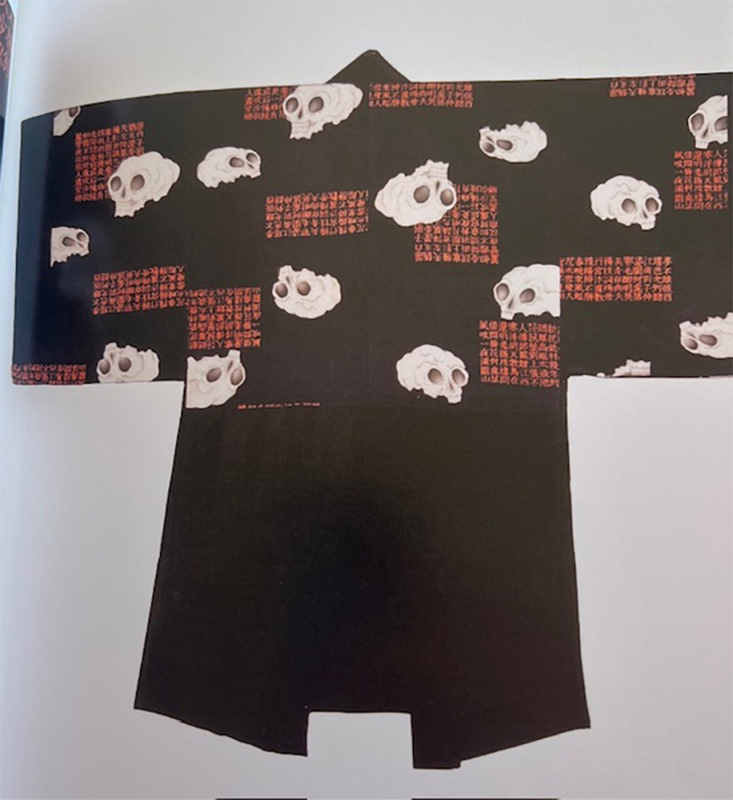
Photo 3 is a haori, or a jacket worn over a kimono for warmth. It is the lining, or haura, that is decorated with bleached white skull motifs, contrasted with blocks of red text on black silk background. The text is normally written in continuous horizontal fashion, not broken up by blocks of texts as if sutras or Buddhist chants. Haori uses less material so is generally less expensive than a kimono. The Jacobsen collection has 15 haori, some silk and others cotton. This example is silk, which adds to the value.
Photo 4 is an elegant silk nagajuban, that I believe was meant to be seen, always. The owner hosted the party, or he left his home in this classy under kimono to partake in meetings/social settings with fellow colleagues. The bones lying next to the skulls give extra depth, the same as the small flag waving in skeletons arms gives life to image.